Starting a service marketplace can be an exciting step, especially with so many people turning to online platforms for everyday needs. With the service sector projected to surpass $20 trillion in the near future, now is a great time to explore this growing space and uncover the niche that could be your next big opportunity.
To help you claim your place in this rising market, this ultimate guide covers everything you need to start your services marketplace.
By the time you finish our blog, you’ll have all the key insights you need, covering everything from defining your niche to acquiring service providers and clients.
Ready? Here’s how you can start your service marketplace!
Key Takeaways
- The 6 core steps to start a service marketplace: niche selection, audience targeting, business model, legal setup, tech, and growth strategies.
- Address pain points for both clients and providers to increase your services marketplace value and create network effects for sustainable growth.
- Ensure transparency in pricing, legal agreements, and secure tech features to build trust and foster user engagement.
But first, as always, let’s cover the basics.
What Exactly Is a Service Marketplace? (in Simple Terms)
A service marketplace is a digital platform that connects both service providers and clients in a single location. It helps people find the services they need from those who provide them.
To simplify it, let’s say your lawn needs mowing or your house needs cleaning, but you don’t have the time, or you simply don’t want to do it yourself. So what do you do?
You just hop on a site like TaskRabbit, choose the task you need done, and someone shows up to do it for you.
If you’ve ever hired help this way, you’ve already used a services marketplace.
In this setup, TaskRabbit is the marketplace platform. You are the client.
The person who shows up to mow your lawn or clean your house is the service provider.
It’s basically the same idea as using Uber, except instead of ordering a ride, you’re hiring someone to take care of whatever service you need, from everyday chores to more specialized tasks.
With the base covered, it’s time to build on it.
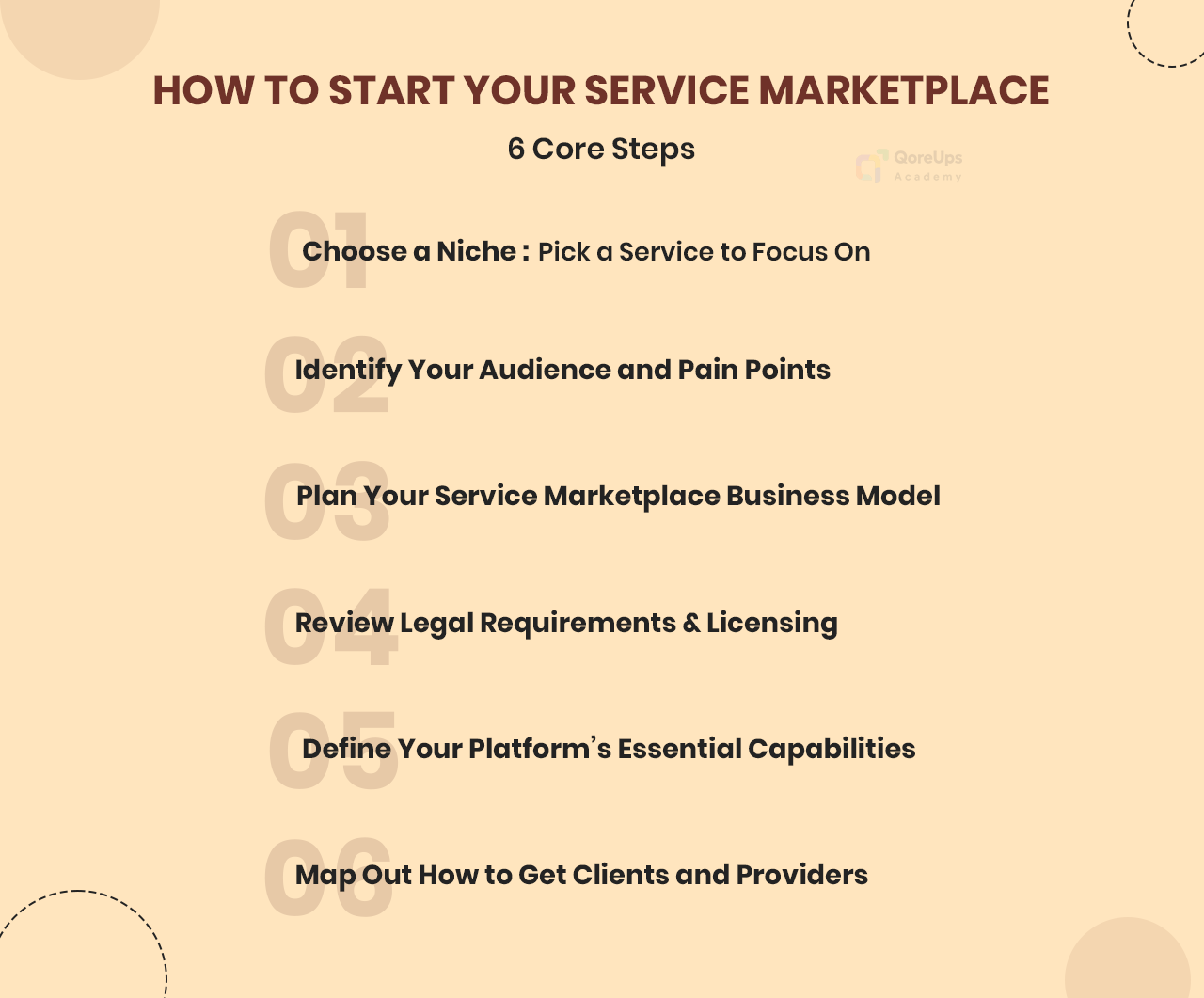
How to Start Your Service Marketplace: 6 Core Steps
To start your marketplace for services, you need to take on these 6 steps.
- Choose a Niche: Pick a Service to Focus On
- Identify Your Audience and Pain Points
- Plan Your Service Marketplace Business Model
- Review Legal Requirements & Licensing
- Define Your Platform’s Essential Capabilities
- Map Out How to Get Clients and Providers
Now that the overview is done, it’s time to explore them in more detail.
#1. Choose a Niche: Pick a Service to Focus On
To start your services marketplace, this is an important step. It’s not just the first step but also the one where many people tend to get stuck. They either pick a niche that is too broad or one that has no demand. The sweet spot lies in the middle.
Choosing a niche starts with a simple question: What problem are you solving? The services marketplace industry is experiencing explosive growth, with a key segment (freelance platforms) alone projected to grow at a CAGR of 17.7% between 2025 and 2030 (Grand View Research).
Focusing on a clear niche helps you take advantage of this growth without trying to do too much at once.
For example:
- Are you helping homeowners find repair services?
- Are you helping event planners discover local vendors?
- Are you helping parents book tutors?
- Are you helping pet owners find sitters?
Every service marketplace needs a niche for one thing. Purpose.
A niche gives your marketplace for services something important. Focus. You do not need to launch with a hundred categories. Start with one clear niche. Build traction. Expand only when users trust your brand.
If you try to serve everyone on day one, you end up serving no one.
Don’t try to catch every fish at once. Start with the basics by reflecting on whether:
- People search for it often
- Providers want more customers
- The current solutions are slow, outdated, or confusing
- You see complaints in forums or review sites
- You personally feel the problem
Entrepreneurs often choose niches based on their own experiences. That’s not a bad approach.
If you’ve felt the pain point, you understand it better than most.
Looking for the perfect idea to pursue? Our blog on “Service Marketplace Ideas: Best Niche to Explore” can guide you!
Now, let’s take the next step.
#2. Identify Your Audience and Pain Points
Once you know your niche, the next step is understanding who needs the service and what they struggle with.
Your marketplace will have two audiences.
- Customers/Clients
- Service providers.
Here’s what each of them is looking for.
1. Customers/Clients
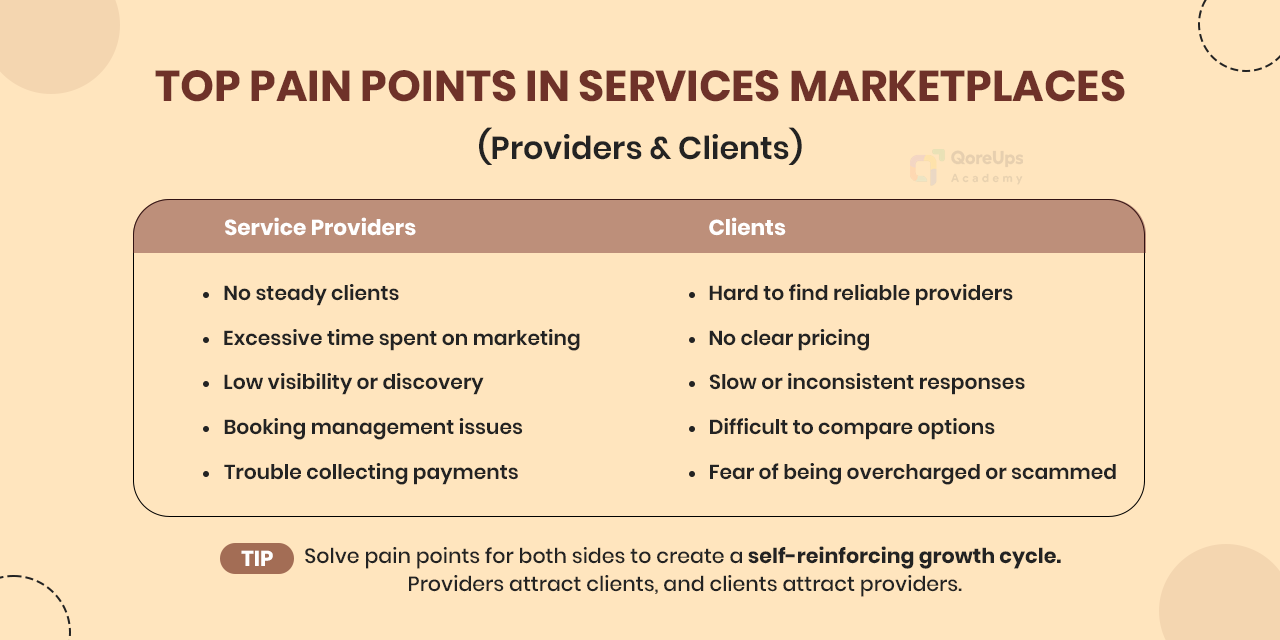
These are people searching for a service, and they face some common frustrations. Here’s what they usually deal with:
- Hard to find reliable providers
- No clear pricing
- Slow response times
- No easy way to compare options
- Fear of being overcharged or scammed
By addressing customers’ pain points strategically, your service marketplace can capture demand, attract and retain users, and maximize engagement and lifetime value.
2. Service providers
These are people offering the service. Their pain points often include:
- No steady clients
- Too much time spent on marketing
- Poor visibility
- Difficulty managing bookings
- Trouble collecting payments
Understanding and solving service providers’ pain points can give your marketplace a strong network effect. More providers attract more customers, engagement rises, and the platform’s overall value expands, creating a scalable, high-growth marketplace for services.
A study in Business Research shows that in marketplaces, one side of the platform directly affects the other. By designing your platform to serve both customers and service providers, you can create a self-reinforcing growth cycle.
This is called cross-side network effects, which means the more users there are on one side, the better the marketplace becomes for the other side.
For example, more customers make the platform more valuable for service providers, and more providers make it more valuable for customers by offering more options.
💡 Pro tip: Many successful marketplaces thrive not by offering more features, but by solving the biggest friction points for both sides of the platform.
#3. Plan Your Service Marketplace Business Model
This is where the fun (and the math) begins. You’re launching a services marketplace for one big reason: it has to put money in your pocket. How? That depends on your niche, your audience, and a little creativity.
Here are a couple of standard revenue models you can tap into with your service marketplace.
- Commission Fee: A percentage charged from your users (clients & providers) for each booking or transaction.
- Subscription Fee: A recurring cost for access to your service marketplace or exclusive features.
- Listing Fee: A single charge to list in your marketplace for services.
Most marketplaces use a mix. For example, a services marketplace may charge a percentage on every booking and also offer subscription plans for providers who want higher visibility.
The good news is that customers and providers are used to these models. You do not need to reinvent anything; just do it right.
The key is transparency. No one likes hidden fees. Make sure your revenue model is crystal clear.
Remember: a simple, transparent revenue model doesn’t just earn you money but also keeps users coming back, recommending your platform, and feeling confident in every transaction.
Helpful Hint: Turn providers into promoters: they refer others, earn rewards, and help your marketplace expand organically while enhancing engagement and loyalty.
For a broader view of marketplace monetization, you can explore our guide on popular online marketplace business models.
Learn, Master, and Achieve Marketplace Success – Join QoreUps Academy Today!
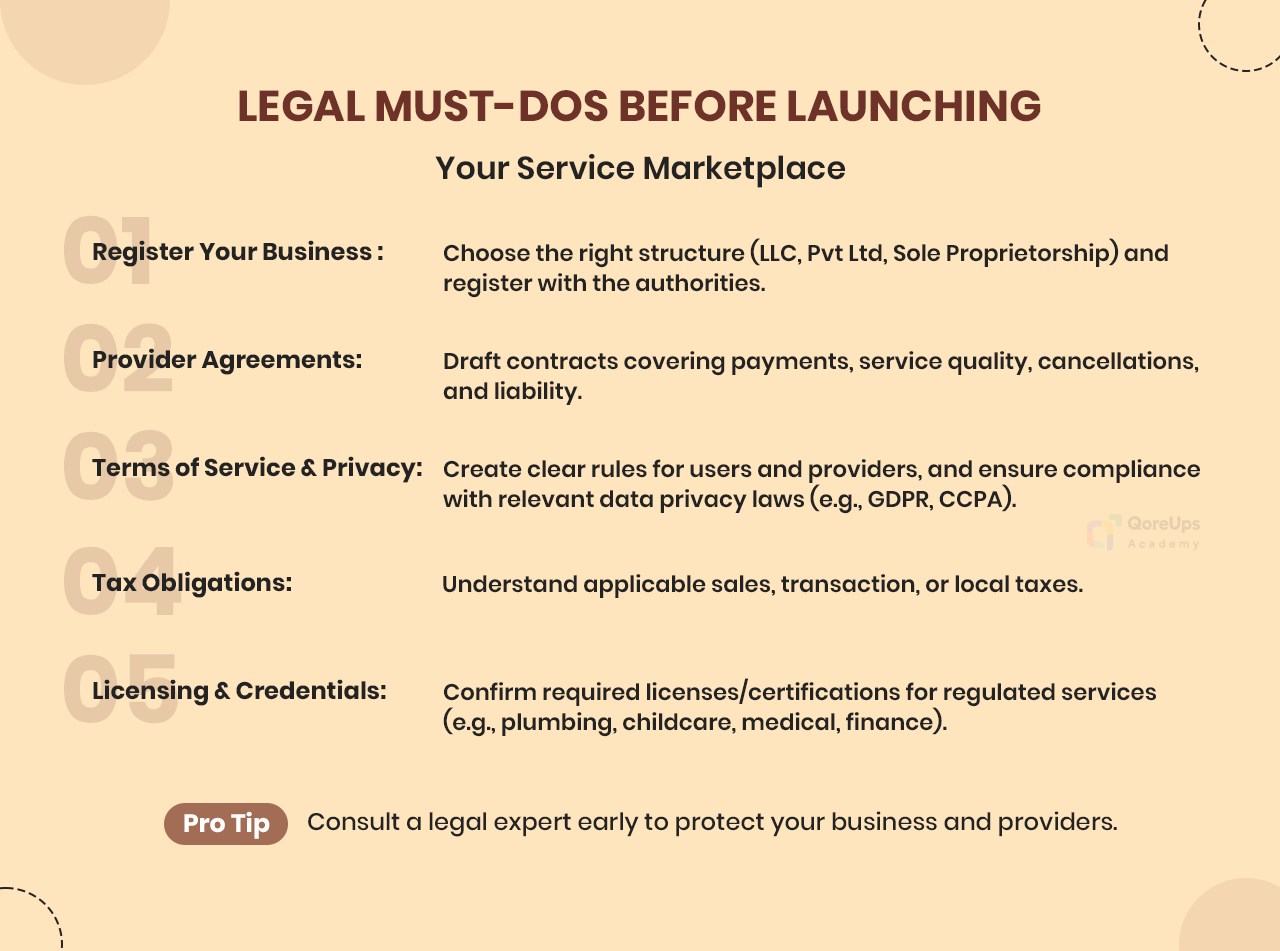
#4. Review Legal Requirements & Licensing
When you think about legal requirements and licensing, they can feel like two of the most intimidating terms you come across when starting your own marketplace for services.
Don’t worry, let’s break it down into easy, bite-sized pieces. What you need to do is:
- Register your business legally
- Choose the right structure for your country, like an LLC, Pvt Ltd, or sole proprietorship. This will determine your taxes, legal protection, and ownership rules, so pick what feels right for your business.
- Register your business with the proper authorities and get a registration number or equivalent.
- Set up provider agreements
- Draft contracts that explain how providers use your platform, including expectations, payment terms, service quality, and liability. Include clauses for cancellations, refunds, and dispute resolution.
- Clear agreements protect both you and your providers.
- Create terms of service and privacy policies
- Explain how users interact with your platform and set rules for both customers and providers.
- Cover data collection, storage, and usage practices to comply with privacy laws. This builds trust and reduces legal risk.
- Understand tax obligations
- Don’t forget to check the tax requirements for your service marketplace.
- This may include sales tax, transaction taxes, or any other local taxes applicable to the services offered through your platform.
- Ensure compliance with data protection laws
- If your marketplace handles personal data, you must ensure compliance with relevant privacy and data protection laws, including GDPR (General Data Protection Regulation) in the EU, CCPA (California Consumer Privacy Act) in the USA, and other local privacy regulations.
- Implement basic data security practices (encrypted storage, secure payments).
- Check licensing requirements for specific service providers
- Certain services (plumbing, childcare, medical, and financial) may require provider licenses or certifications.
- Decide whether to verify provider credentials or require them to provide proof.
✅ Tip: You don’t need to be a legal expert to get started, but it’s a good idea to consult one early, especially for provider agreements, liability, and local licenses.
#5. Define Your Service Marketplace’s Main Components
When launching your marketplace, you have two choices:
- Custom Build: Full control, but it takes more time and money. You’ll need a team to make it happen.
- SaaS marketplace platform: Launch faster with hosting, security, and features already included. You give up a bit of control for speed.
When testing a new idea, use online marketplace software or a simple custom version, and validate your market before investing heavily.
Tech choices influence the experience, but simplicity should be your focus at launch.
Your service marketplace needs:
- Real-time calendar sync to avoid double bookings.
- Mobile-friendly interface to make it easy for users to conveniently access it on their phones
- Secure payments and split payouts. Providers need fast and clear payouts.
- Messaging or chat so customers and providers can talk in real time.
- Reviews tied to verified bookings to keep ratings honest.
- Basic analytics on bookings and revenue for you to keep track of your growth.
Still deciding between custom, SaaS, or scratch? Our guide on building a marketplace: SaaS vs custom vs scratch can help!
#6. Map Out How to Get Clients and Providers
You can build the best marketplace in the world, but if no one knows about it, nothing happens. Growth comes from two sides. Getting providers and getting customers.
Here is the truth. Most service marketplaces start by focusing on providers first. Without providers, customers see an empty marketplace. But once you have providers, customers get value from day one.
As we mentioned with cross-side network effects, when one side feels valued, the other side benefits as well.
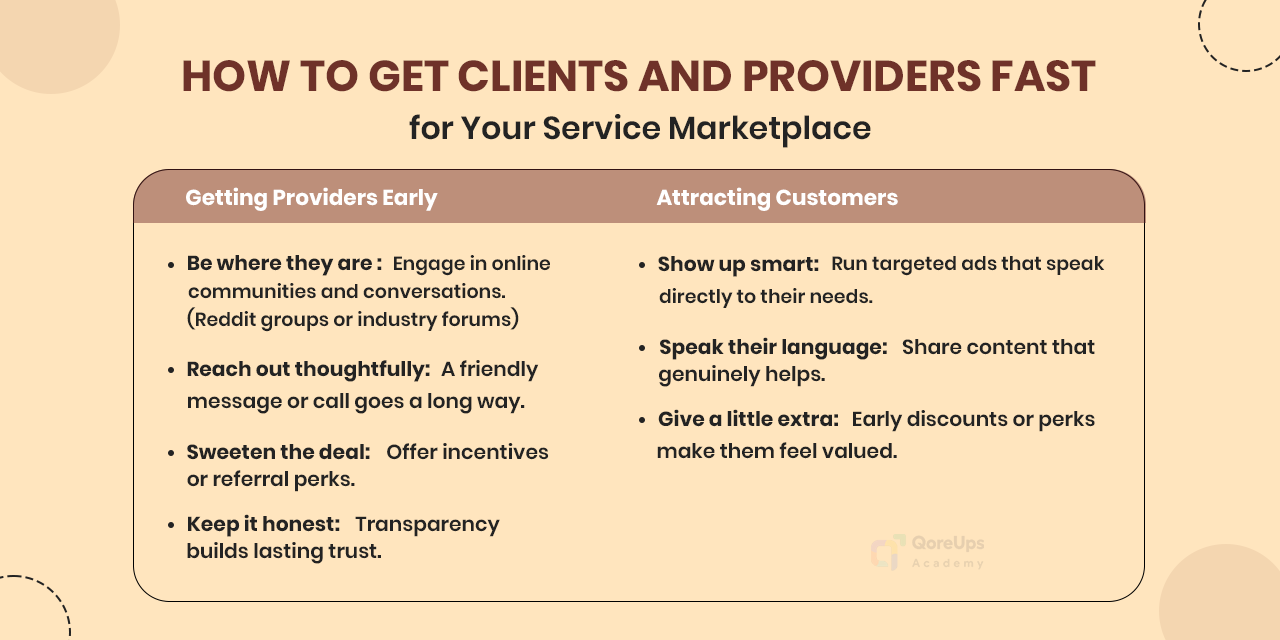
To get providers early into your service marketplace:
- Get involved in online communities: Join groups where your providers are active and start connecting.
- Reach out personally: A direct message or call goes a long way in building early relationships.
- Sweeten the deal with incentives: A little extra motivation can turn interest into action.
- Offer a referral bonus: Providers love sharing great opportunities. Make it easy to build connections and foster loyalty.
- Build trust through transparency: The more open and honest you are, the easier it is to build long-term relationships.
For customers:
- Run targeted ads that speak directly to them: Show up where your ideal customers are already looking.
- Create content that speaks to their needs: Organic content helps you connect on a deeper level.
- Give them a little extra with early discounts: A special offer for those who jump in first can go a long way.
Smart Strategy: As trends evolve, authenticity, local SEO, and community partnerships will drive success. Consumers are looking for real, meaningful connections, and that’s especially important for service marketplaces. Focus on authentic content and local relationships to set your business up for lasting growth.
Final Thoughts: Embrace the Service Marketplace Opportunity!
Starting a marketplace for services can feel overwhelming when you first think about it. But when you break it into smaller steps, it becomes something anyone can approach.
A services marketplace does not need perfection to launch. It needs clarity, consistency, and a willingness to learn. The most successful platforms in the world did not start big. They started focused, solving real problems and listening to their users. Step by step, they grew steadily.
If you stay committed to solving a real problem, your service marketplace has every chance to succeed.
At the beginning of your journey? Stay on top of everything you need to know about building a successful service marketplace with QoreUps Academy.
And hey, if this was helpful, don’t keep it to yourself. Go ahead and share it!