Service marketplaces are everywhere, but good ideas are not.
When people think about building a service marketplace, they often jump straight to the tech. Software matters, of course. Just not first.
Before you touch code or sketch features, you need to get one thing right: choosing the right niche.
Many services are highly competitive, some are poorly structured, but a few remain underdeveloped with strong growth potential. The question is how to find that one service marketplace idea that can set your marketplace apart and create a great experience for users.
Curious about that? Then you have to keep reading the blog, because that’s exactly what we are going to cover here.
By the time you reach the end, your service marketplace niche should feel a lot clearer.
Not just popular ideas, but ideas that make sense today, in real markets, with real demand, and some learnings from the path of the popular service marketplaces.
Ready? Let’s go!
Top 30 Service Marketplace Ideas That Are Highly Profitable Today
Rather than listing things dryly, let’s talk through these ideas the way you can actually think about them. Some are familiar. Others are quietly growing under the radar.
Sorry to sneak this in, but before we go on, hit subscribe. We promise the best marketplace tips and insights delivered fast and free.
Now, back to the blog!
Let’s make this easier by breaking them into 7 top-earning categories:
#1. Healthcare & Wellness Services
This category requires care and compliance, but demand is strong.
With the rise of AI, more people are turning to tools like ChatGPT for health-related queries and to decide if a doctor’s visit is necessary. From diagnostics to treatment plans, counseling to recovery support, your online service marketplace platform can provide it all, giving people the chance to find flexible care options.
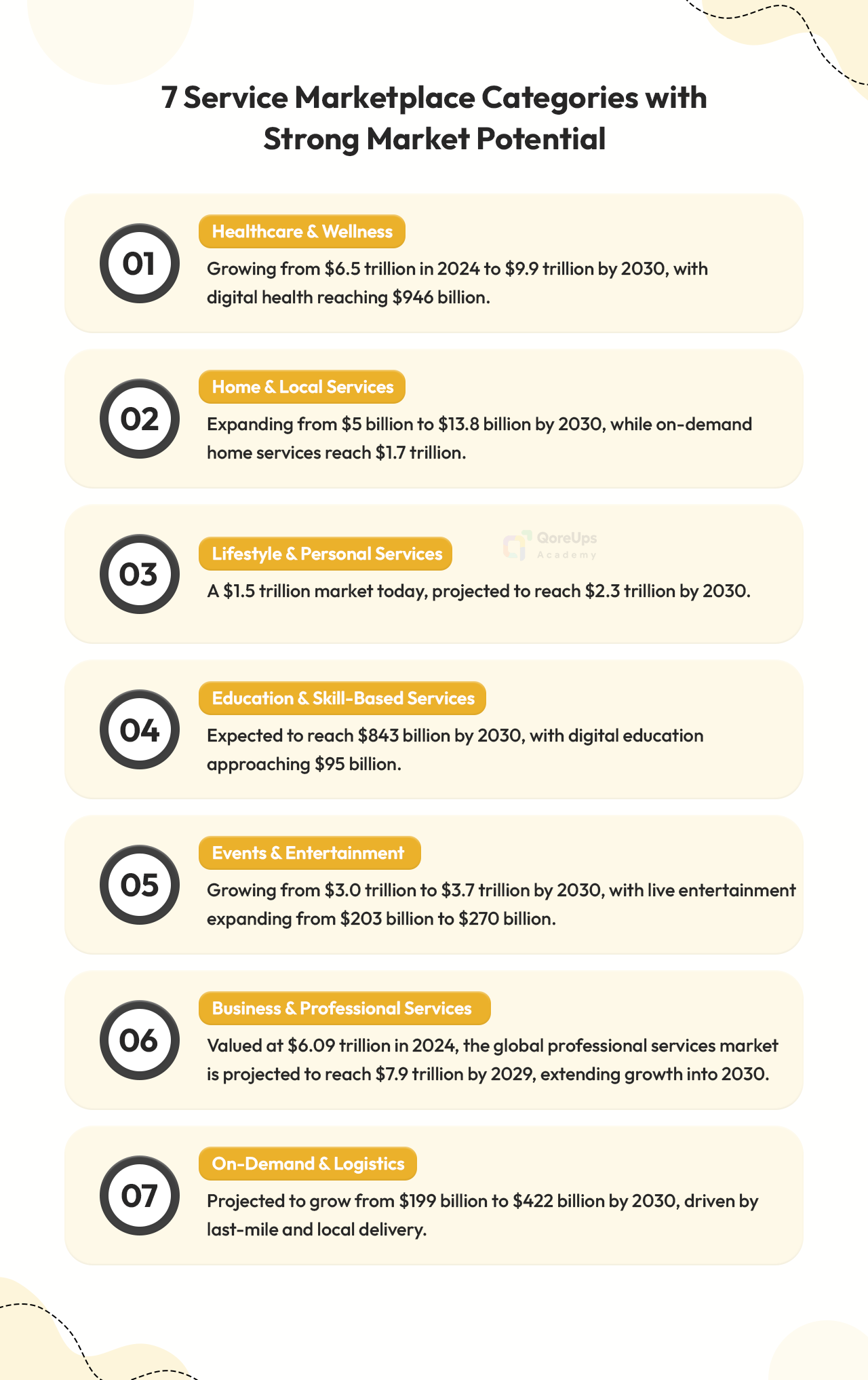
For founders asking, “Why this niche?” the numbers speak for themselves. The health and wellness market is set to grow from $6.5 trillion in 2024 to nearly $9.9 trillion by 2030, with digital health alone racing toward $946 billion at a 22.2% annual growth rate (Grand View Research).
Here’s a list of service marketplace ideas in the healthcare space:
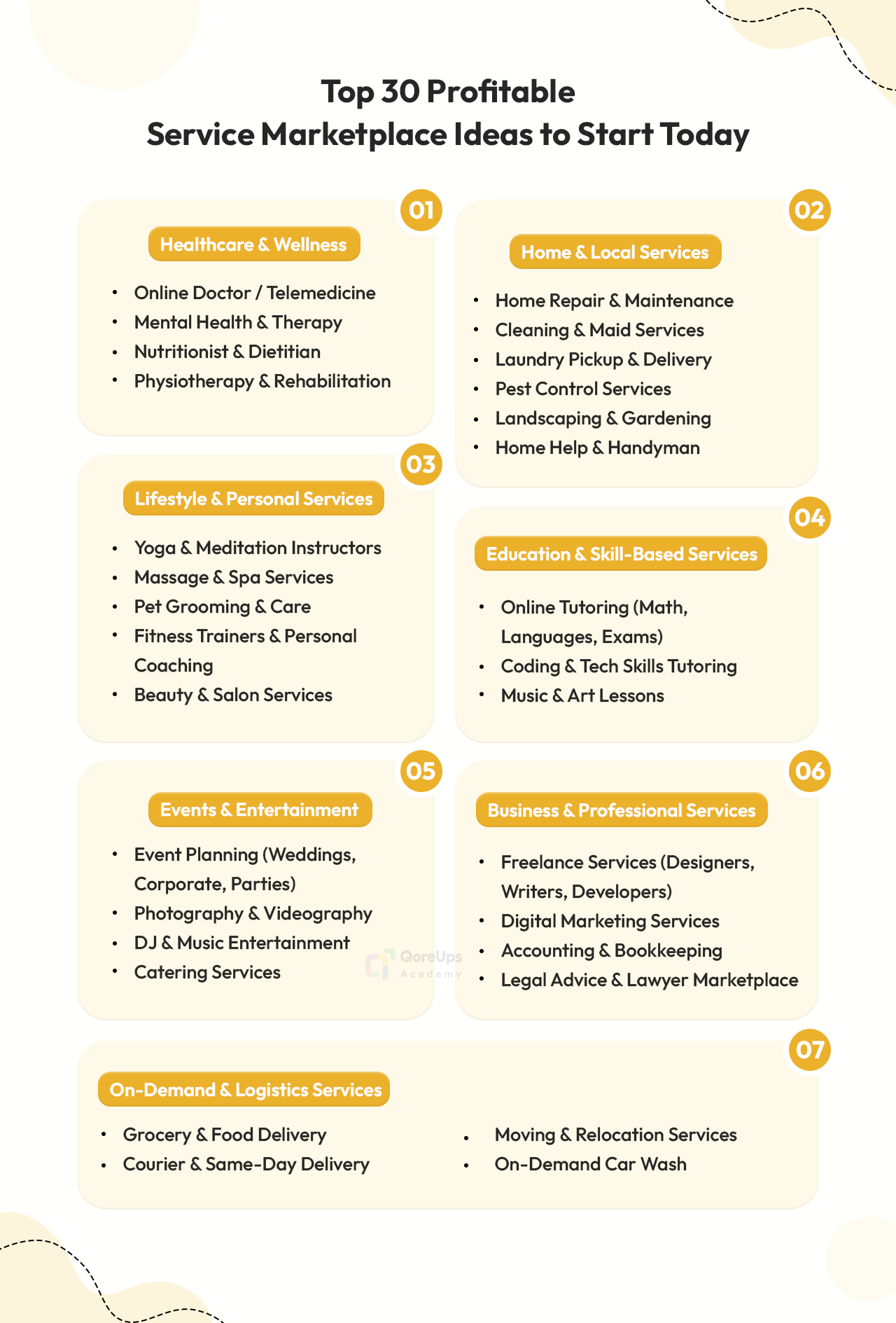
- Online Doctor / Telemedicine Service Marketplace: Video consultations, scheduling appointments, e-prescriptions.
- Mental Health & Therapy Marketplace: Instant access to therapists, counselors, and psychologists.
- Nutritionist & Dietitian Booking Platform: Customized diet plans, online consultations, follow-ups.
- Physiotherapy & Rehabilitation Services Marketplace: Therapy session bookings for in-clinic and at-home sessions.
Next,
#2. Home & Local Services
These services aren’t showy, but they’re all reliable and in constant demand.
Why the demand, you ask? Simple. Home services are rarely one-time needs. From cleaning to maintenance, people need help repeatedly. Also, they want quick access to trusted professionals without searching from scratch every time.
Wondering why this niche matters? Home services are scaling fast, growing from $5B to $13.8B by 2030. Beyond that, the broader on-demand home services market is heading toward $1.74 trillion, growing at a 24.19% CAGR through 2030.
Below are service marketplace ideas focused on home and local services:
- Home Repair & Maintenance Marketplace: Plumbers, electricians, carpenters, and technicians.
- Cleaning & Maid Services Marketplace: Regular, deep, and move-in/move-out cleaning services.
- Laundry Pickup & Delivery Marketplace: Washing, dry cleaning, ironing, and real-time order tracking.
- Pest Control Services Marketplace: Residential and commercial pest management.
- Landscaping & Gardening Marketplace: Lawn care, garden design, and maintenance services.
- Home Help & Handyman Marketplace: Small fixes, installations, and household tasks.
After health and home, we are going to move to personal care.
#3. Lifestyle and Personal Service Marketplaces
There are plenty of reasons to build a service marketplace for this niche. People love anything that makes their lives simpler or more enjoyable, and that’s exactly where these services shine. Consider wellness and personal coaching, the kind of offerings that keep customers coming back for more.
After all, many people prefer joining a yoga class from the comfort of home instead of planning travel around a 60-minute session.
Let’s talk money. The global lifestyle and personal services market is already a trillion-dollar beast, and it’s only getting bigger; it’s projected to rise from $1.53 trillion in 2025 to over $2.29 trillion by 2030.
What’s truly captivating? High-value niches. Integrated wellness already pulls in $1.43 trillion. Online beauty is on track for a 33% digital share. Coaching is booming, and lifestyle services now make up15% of the market.
Inspiration for your lifestyle online service marketplace platform:
- Yoga & Meditation Instructor Marketplace: Live, recorded, and private wellness sessions.
- Massage & Spa Booking Platform: At-home relaxation and therapy services.
- Pet Grooming & Care Marketplace: Grooming, dog walking, pet sitting, and training.
- Fitness Trainer & Personal Coaching Platform: Online and in-person fitness sessions.
- Beauty & Salon Services Marketplace: At-home and in-salon beauty professionals.
After some self-care, it’s time to give our brains a boost with,
#4. Education & Skill-Based Services
Skill-based online services are where the growth is exploding. E-learning platforms, tutoring, and professional development alone are projected to reach $843 billion by 2030, growing at a strong 19% CAGR. Digital education specifically is on track to top $95 billion, with a 24% annual growth rate.
Today, language learning, test prep, career coaching, coding lessons, music, and even creative skills are all booming in online service marketplace platforms.
From parents to professionals, people want help they can trust. The trick? Specialization.
When you build a service marketplace, you can’t cater to everyone and everything. If you choose to dilute your marketplace, you’ll end up being a “Jack of all trades, but a master of none.”
Ideas to spark your online education marketplace:
- Online Tutoring Marketplace: Math, science, languages, and school subjects, as well as competitive exams.
- Coding & Tech Skills Tutoring Marketplace: Programming, AI, data science, and IT skills.
- Music & Art Lessons Booking Platform: Instruments, singing, painting, and creative arts.
While others scroll, you could be mastering your next marketplace win. Join QoreUps Academy now!
#5. Events & Entertainment Services
Events and entertainment sit at the heart of how people come together and have fun, which makes this category especially popular in service marketplaces.
Whether it’s live music, event planning, or party entertainment, customers want trusted providers to create special moments. With your marketplace, you can offer easy access to the right talent for every event.
Why this niche? Media and entertainment are huge, expected to grow from $3 trillion in 2025 to $3.66 trillion by 2030. Live entertainment is growing fast on its own, from $202.9 billion to $270.3 billion, driven by demand for performers, DJs, and venues.
Everything’s moving online, and that’s where the opportunity is.
Paths to explore for your Events & Entertainment services platform
- Event Planning Marketplace: Weddings, corporate events, parties, and festivals.
- Photography & Videography Booking Platform: Events and personal shoots.
- DJ & Music Entertainment Marketplace: DJs, bands, and live performers.
- Catering Services Booking Marketplace: Event-based and recurring catering services.
#6. Business & Professional Services
This category is all about providing businesses with the support necessary for smooth operations. It covers various services, from accounting and legal advice to marketing help, IT support, and virtual assistance.
These are services that companies often need but may not have in-house.
Here’s the opportunity. The professional services market is huge, valued at $6 trillion and growing. Freelance work, a major part of B2B e-commerce, is set to nearly double by 2030. Marketplaces already handle 65 percent of B2B transactions, showing businesses prefer platform-based solutions.
Either way, they make a real difference, helping businesses of any size achieve more with less stress.
A few service ideas for your business-focused online service marketplace:
- Freelance Services Marketplace: Designers, developers, writers, and consultants.
- Digital Marketing Services Marketplace: SEO, ads management, and social media services.
- Accounting & Bookkeeping Marketplace: Small business and startup financial services.
- Legal Advice & Lawyer Marketplace: Consultations, documentation, and compliance.
#7. On-Demand & Logistics Services
From a last-minute delivery to a big move across town, this category is all about being there when you need it most. On-Demand & Logistics Services handle the busywork, so life and business can keep moving without a hitch.
If you’re thinking about growth, here’s a hint: on-demand logistics is on fire, projected to grow from $199 billion in 2025 to $422 billion by 2030.
Handful of ideas to jumpstart your online service marketplace:
- Grocery & Food Delivery Service: Convenient delivery for groceries, snacks, and meals.
- Courier & Delivery Services Marketplace: Local and same-day delivery providers.
- Moving & Relocation Services Platform: Residential and office moving services.
- Car Wash at Home Marketplace: On-demand vehicle cleaning services.
Now that you’ve explored the niches, hopefully you’ve found one to start your service marketplace. Next, let’s check out some key lessons from the leading names in the industry.
What We Can Learn From Real-World Service Marketplaces
When people talk about building a service marketplace, they always bring up the same names. Uber. Fiverr. Upwork. TaskRabbit. Justdial.
These platforms are everywhere, so it feels natural to study them and think, “I’ll just do what they did, but just on a small scale.”
That thinking is also where many go wrong.
Let’s look at a few real-world service marketplaces and what they quietly teach us.
Why Blatantly Copying Uber’s Model Rarely Works
Uber is often used as the default example of a service marketplace. Two sides. Drivers and riders. Simple matching. But what made Uber work was not the model. It was timing, regulation gaps, and extreme focus on one painful problem.
In the early days, Uber was not trying to be a global transport solution. It focused on black car services in a few dense cities where taxis were unreliable and expensive. That narrow entry point mattered.
What you can learn from this:
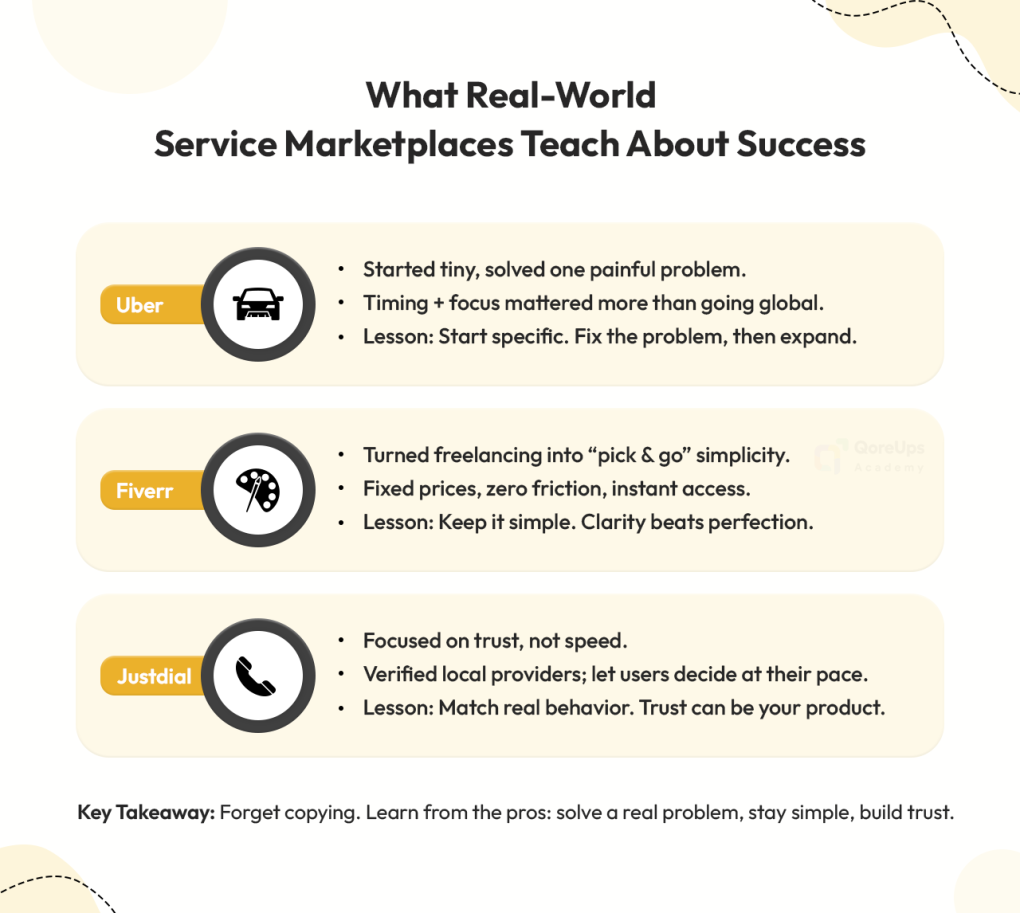
- Uber did not start broad. It started painfully specific.
- It solved a problem people already complained about daily.
- Expansion came later, after demand was proven.
The lesson is not to copy Uber’s scale but to copy its obsession with a single clear pain point.
How Fiverr Won by Making Freelancing Easy
Fiverr did something that many experts said would never work. It turned services into simple listings with fixed prices. Designers, writers, voice artists, and marketers were all packed into one marketplace.
At first, Fiverr was seen as low quality. But that was exactly the point.
They leaned into speed and accessibility. No long proposals. No bidding wars. Just pick a service and buy it.
Over time, Fiverr added layers. Higher pricing. Pro sellers. Custom offers. But the core idea stayed simple.
What you can learn from this:
- Early marketplaces do not need perfection. They need clarity.
- Removing friction can matter more than adding features.
- Reputation systems can evolve as quality improves.
If you are building a marketplace for services, this shows that you do not need to start premium; just create something functional.
Why Justdial Worked by Owning Local Trust, Not Speed
Justdial did not win because it was the fastest or the most modern. For years, it was not even fully digital; it primarily stayed just as a telephone-based directory. In India, when someone needs a plumber, a tutor, or an electrician, the first concern is not speed.
It is trust.
Nearby options? Experienced contacts? And who will actually pick up the phone?
Justdial leaned into that reality.
It focused on verified local listings, phone calls, and reviews.
- Service providers were not freelancers chasing gigs. They were existing businesses already serving neighborhoods. Justdial simply became the bridge.
- Buyers could call, ask questions, and decide. No pressure to book instantly. No complex checkout. Just enough information to feel confident.
Justdial didn’t chase the global trend of instant transactions. It leaned into a simple truth: in India, people like to talk before they decide. The conversation became the product, not the problem.
What you can learn from Justdial:
- A service marketplace does not need to force bookings to create value.
- Local trust can matter more than platform speed.
- Matching how people already behave often beats changing habits.
Your online service marketplace platform can win by organizing demand, not owning the transaction.
You do not need to copy anything. Fiverr made it simple. Uber made it instant. Justdial made it human.
The real question is: what are you going to do?
Want to learn more from successful marketplaces? Our blog explores top lessons from successful online marketplaces and shows how they solved real problems.
What Are the Underserved Areas in Service Marketplaces Worth Exploring?
When people think about online service marketplaces, their minds jump to the obvious winners.
Home cleaning. Food delivery. Freelancers. Ride-hailing.
Proven markets do feel safe, but they’re crowded and costly.
The real opportunities often live in quieter corners. The places where platforms are either messy, impersonal, or just don’t work.
These gaps are often where the best chances to build a service marketplace show up.
#1. B2B Services Are Still Under-Platformed
Consumer services get attention because they are visible. Business services quietly generate more revenue and stick around longer.
Small and mid-sized businesses struggle to find reliable providers for bookkeeping and compliance, IT support and cybersecurity, equipment servicing, and HR and payroll operations.
Many companies rely on outdated directories or personal networks. Large firms have enterprise vendors. The middle is underserved.
An online services marketplace focused on B2B needs does not need millions of users. It needs fewer, higher-quality transactions and repeat relationships.
Curious how B2B marketplaces thrive? Our blog on “How do B2B marketplace make money” can help you out!
#2. Skilled Blue-Collar Work Is Still Poorly Organized
White-collar services went digital early. Designers, developers, writers, and consultants have plenty of platforms.
Skilled blue-collar services are a different story.
Electricians, welders, machine operators, elevator maintenance crews.
These are high-skill roles with real economic value.
Many earn well, yet their work is still sourced through referrals and long-standing relationships.
Why is this underserved?
Because these services are harder to standardize. Jobs vary. Pricing is not fixed. Trust matters more than speed.
#3. Services Tied To Life Transitions
Some of the most stressful moments in life involve services. Moving to a new city. Starting a family. Recovering from illness. Managing a loss.
During these moments, people are overwhelmed. They do not want to search across ten platforms.
This opens space for bundled or guided service marketplaces. Platforms that help users navigate a phase, not just book a task
For instance,
- Relocation services combining movers, cleaners, and setup
- Post-hospital care coordination
- Property handover and resale services
The underserved part here is not the service itself. It’s the experience. Most platforms treat these as isolated bookings instead of connected needs.
If you’re a founder who cares more about how people move through a service than just completing a transaction, that’s where new value often shows up
Now that the idea’s in your head, it’s time to get it off the page and make it happen.
Moving From an Idea to Building a Service Marketplace
Okay, so let’s say you’ve picked a niche. You can picture the kind of services, the people offering them, and the people who might pay for them.
Now comes the obvious question: what are you going to do next?
If your instinct is to jump straight into the service marketplace development process, slow down.
At this point in your journey, think less about features and more about flow.
Before writing code or choosing service marketplace software, talk to people.
Spend time with your potential users,
- How do people usually find help when they need it?
- What was the last service experience that went wrong?
- Where did they feel unsure, rushed, or stuck?
Mind you, these questions may sound simple, but the answers rarely are.
After a few real conversations, patterns start to show up. When you hear the same frustrations again and again, that’s your signal. You’re not just listening anymore. You’re staring at a service marketplace waiting to be built.
Think you’ve got a winning marketplace idea? Go on, take action!
Wrapping up,
When you set out to build a service marketplace, you soon realize success doesn’t come from random decisions.
They come from listening, observing, and connecting the dots.
The best service marketplace ideas don’t chase trends. They listen carefully, notice what’s broken, and fix it thoughtfully.
If this guide helped you see opportunities a little more clearly, you’re already moving in the right direction. If choosing a niche to build a marketplace now feels a bit less messy, then our blog did its job.
And hey, subscribe to QoreUps Academy to navigate the next steps of your service marketplace venture with practical insights.
If you know someone wrestling with these same questions, send this their way!